Hormonal Health · Menopause Care
Perimenopause and menopause symptoms managed by an Indian Menopause Society-certified physician — not brushed off as 'just aging.'
Menopause care at Furia Clinic in Ghatkopar East, Mumbai starts by taking your symptoms seriously — hot flashes, sleep disruption, mood changes, and metabolic shifts are all reviewed together, with treatment options (hormonal and non-hormonal) explained clearly rather than assumed.
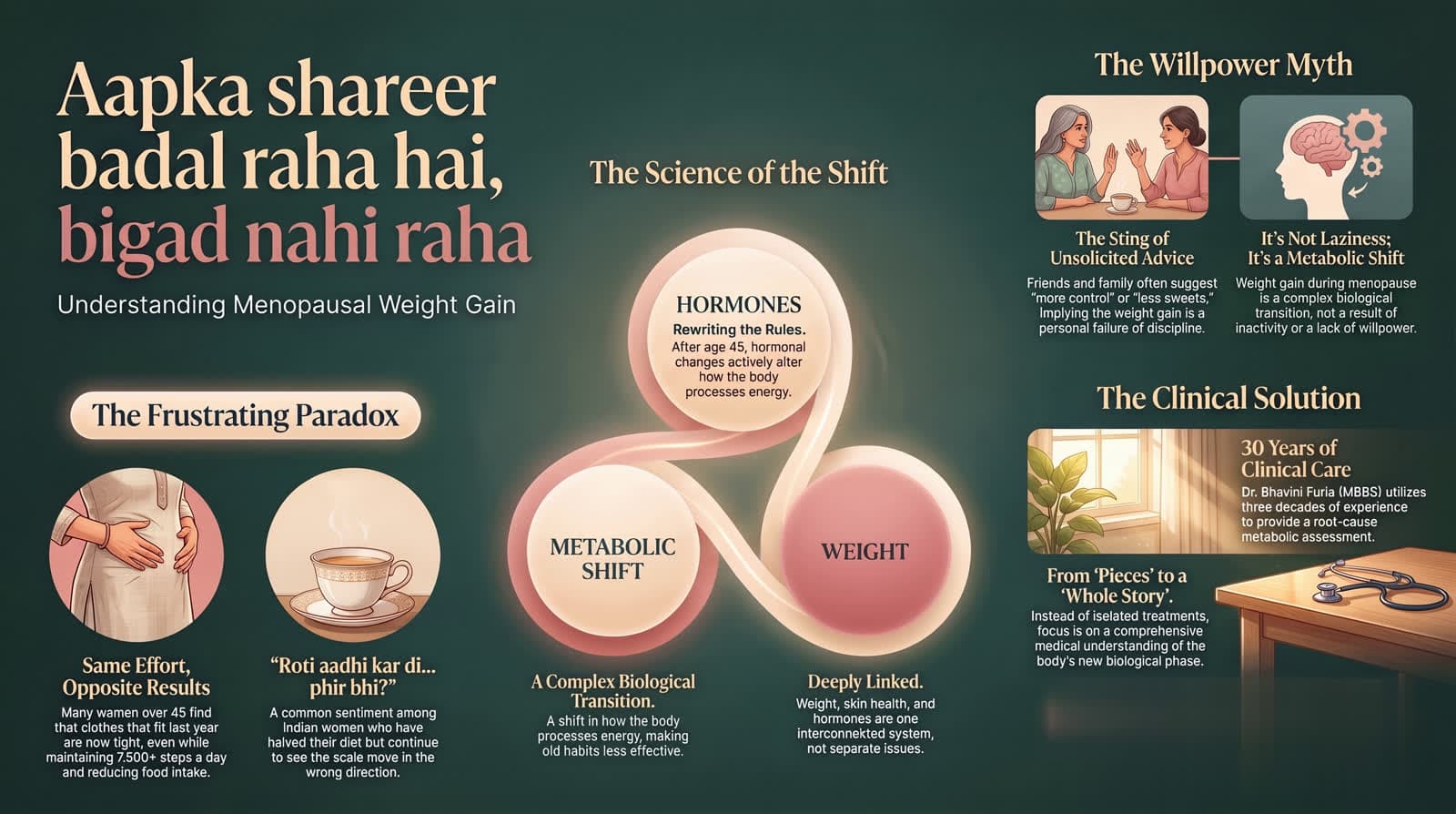
A short explainer on the hormonal and metabolic shift behind menopausal weight change, and why the same diet and exercise stop working.
If you’re over 45 and clothes that fit last year feel tight now — even though your morning walk and your portion sizes haven’t changed — you’re describing something real and common. It isn’t a sudden loss of discipline. It’s a change in how your body uses energy.
Around perimenopause and menopause, falling and fluctuating estrogen shifts several things at once:
None of these are caused by eating more or moving less. They’re a biological recalibration — the rules your body followed in your 30s no longer apply the same way.
Cutting food further on top of an already-shifted metabolism often backfires: it can lower metabolic rate more, increase fatigue, and drive the restrict-then-rebound cycle that leaves you heavier, not lighter. The problem isn’t the size of the effort — it’s that the effort is aimed at the wrong target.
Rather than another restrictive diet chart, menopausal weight change is worked up like any other clinical question: a proper symptom history, hormonal and metabolic labs where they will actually change the plan, and treatment options — hormonal and non-hormonal — explained clearly against your own history. Weight, skin, sleep and mood are reviewed as one connected system, not separate complaints.
A detailed conversation about what you're experiencing and when it started.
Hormonal and metabolic labs ordered where they'll actually change the plan.
Hormonal and non-hormonal options explained clearly, with your history in mind.
Follow-up care as your symptoms and treatment response evolve.
Relevant credentials
No — it depends on your individual history and risk factors, which is exactly what a certified specialist consultation is for.
Yes — perimenopause is treated as soon as symptoms start, not only after menopause is confirmed.
No. It reflects a hormonal and metabolic shift — changes in estrogen, fat storage, insulin sensitivity and muscle mass — not a lack of discipline or effort. Treatment starts from that understanding.
Cutting food further on top of an already-shifted metabolism can lower your metabolic rate and drive a restrict-and-rebound cycle. The effort isn't too small — it's aimed at the wrong mechanism.
A detailed symptom history, hormonal and metabolic labs ordered only where they'll change the plan, and hormonal or non-hormonal treatment options explained against your own history — with weight, sleep, skin and mood reviewed together rather than as separate complaints.
One physician, your full history, a plan built around it — not a template.
Book a Menopause Consultation